

By Aswad Walker
For nearly 40 years, the Black United Fund of Texas (BUFTX) has worked to improve Houstonians’ lives in innumerable ways, all under the banner of helping people help themselves.
Recently, the group has taken on the challenge of improving environmental realities in the Fifth Ward and Kashmere Gardens.
Environmental Challenges
Marcus Glenn, BUFTX’s program developer, said the organization’s environmental focus began in 2020 as reports surfaced about contamination in Fifth Ward, home to six cancer clusters, allegedly caused by Union Pacific Railroad. The contamination, creosote, is a toxic substance linked to cancer.

With BUFTX (2606 Gregg St., Houston 77026) located in that community, the group seized on the opportunity to address a real community concern, help improve residents’ quality of life and remediate some of the contamination.
The ground contamination, confirmed in late 2024 by a Texas A&M study that revealed “significantly elevated levels of heavy metal contaminants,” makes growing healthy, contamination-free food in the area difficult at best. It’s an area that is also a food desert.
Adding to the challenge, Fifth Ward and Kashmere Gardens bear the brunt of Houston’s heat, making already-existing neighborhood health challenges worse, especially for seniors.
“Houston itself is a heat zone, but obviously when there’s more concrete and less trees, then there’s going to be even more heat and more devastation in that area,” explained BUFTX Chief Financial Officer Verlika Thomas.

“Where you are in Houston, you can be experiencing heat really differently,” Dr. Stephanie Piper, Houston Advanced Research Center, said in August 2024.
Fifth Ward is sandwiched between I-10 and 59, and “enjoys” a constant flow of 18-wheelers parading down Lockwood, Waco and other main streets. This area is also home to traditionally heavy-polluting industries—dry cleaning businesses, hospitals and concrete batch plants.
“All these things produce waste. It’s a lot of pollution going on,” Glenn said. “We’re looking for ways to help reduce asthma and different chronic illnesses that are tied to these environmental issues in a holistic way.”
Planting Trees
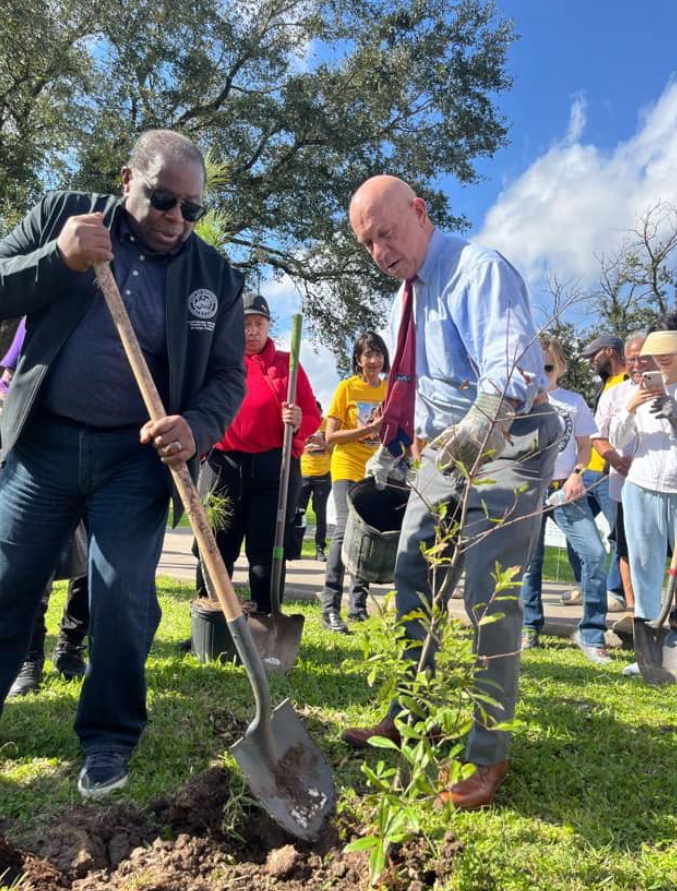
One of those “ways” involves residents getting their hands dirty.
With grant funding from the Environmental Protection Agency (EPA) of $200K in 2020, two major initiatives were funded, one of which offered the area some much-needed shade.
“Our idea of how to remediate that was through planting trees and different solutions,” said Glenn. “We weren’t trying to attack it from a policy standpoint, but just using nature-based solutions or agriculture to be able to address the contamination.”
BUFTX coordinated planting roughly 500 trees in Kashmere Gardens and Fifth Ward, particularly at the BUFTX office, Greater St. Matthews Church and Key and Fleming middle schools.
Hydroponic Farming
With that EPA grant, BUFTX also facilitated the retrofitting of a shipping container, turning it into a hydroponic farm for growing leafy green vegetables. The fresh produce goes to community members and students at Fleming Middle School.
With only one grocery store between Fifth Ward, Kashmere Gardens and Denver Harbor, the fresh food produced by BUFTX offers residents a healthier option than buying “fresh” vegetables from a dollar store.
Not New to This
But to let Cleo Johnson McLaughlin tell it, the organization has been fighting for improved environmental realities for years, though she expands the traditional definition of “environmental issues.
And she should know. McLaughlin has been the president of BUFTX since its founding in 1987.

“We recognized that people in those areas needed substantive training,” said McLaughlin. ‘So, for those who have perhaps been incarcerated or been to war and their discharge is not in place, we could give them an arm in life in order for them to succeed.
“Along with providing these and other community members with food, and some with temporary housing, we’ve provided electrical training programs so we could train people to do significant work in order to help themselves,” McLaughin added.
“The best help is self-help.”
Thomas agrees.
“Realistically, BUFTX has always dealt with environmental issues,” said Thomas. “Environmental issues encompass healthcare, homelessness and underserved communities, which are, of course, food deserts.
“We’ve always created programs or projects and worked with other community-based organizations to address these issues.”
Still, BUFTX’s more traditional environmental justice work, planting fruit and nut trees, covers two environmental justice bases—helping to cool down a heat zone and providing homegrown food to an area Thomas describes as suffering from “food apartheid.”
“We have created the beginnings of a Fifth Ward ‘food forest,’” said Thomas.
Partnerships
BUFTX doesn’t do this good work alone. The organization is a fiscal agent, meaning it raises the funds via workplace campaigns, grants and statewide events. BUFTX then directs those funds to the “conglomerate of agencies” in order for them to work their service/solution-oriented programs.
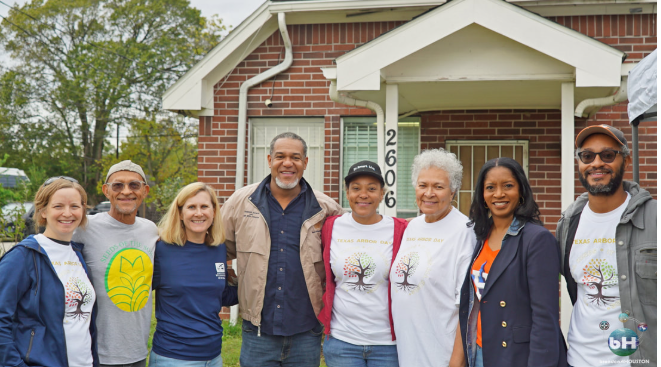
In fact, collaboration is central to BUFTX.
“The EPA grant was a collaborative effort among several organizations, including the City of Houston, Houston Community College and Houston Wilderness,” said McLaughlin.
Help Needed
BUFTX, with EPA grant funding, partnered with the U.S. Environmental Protection Agency, the Houston Health Department, HCC-Northeast’s Global Center for Energy Excellence, The Green Thumb Academy and South Union CDC to offer free solar training to community members. Preference was given to residents of the Fifth Ward, Kashmere Gardens and Denver Harbor. Participants will receive Level 1 and Level 2 NCCER Solar Installation Certificates.
But that funding was taken back.
“That’s kind of where we are now, trying to make sure that one, we’re able to complete the project with the participants we currently have in the program,” said Glenn, “then seeing how it is that we can go ahead and have some type of program going on later on.”
BUFTX actively seeks volunteers and funding partners to help people help themselves.
For more information, visit www.buftx.org or call 713-524-5767.
