


By ReShonda Tate
Black mothers have long carried the weight of a unique and complicated history when it comes to parenting.
For generations, the traditional “tough love” approach—marked by strict discipline and, often, corporal punishment/spanking—was seen as essential for raising children to survive in a world that persistently devalues Black lives. Rooted in protection and survival, these methods aimed to “harden” children against racism and injustice.
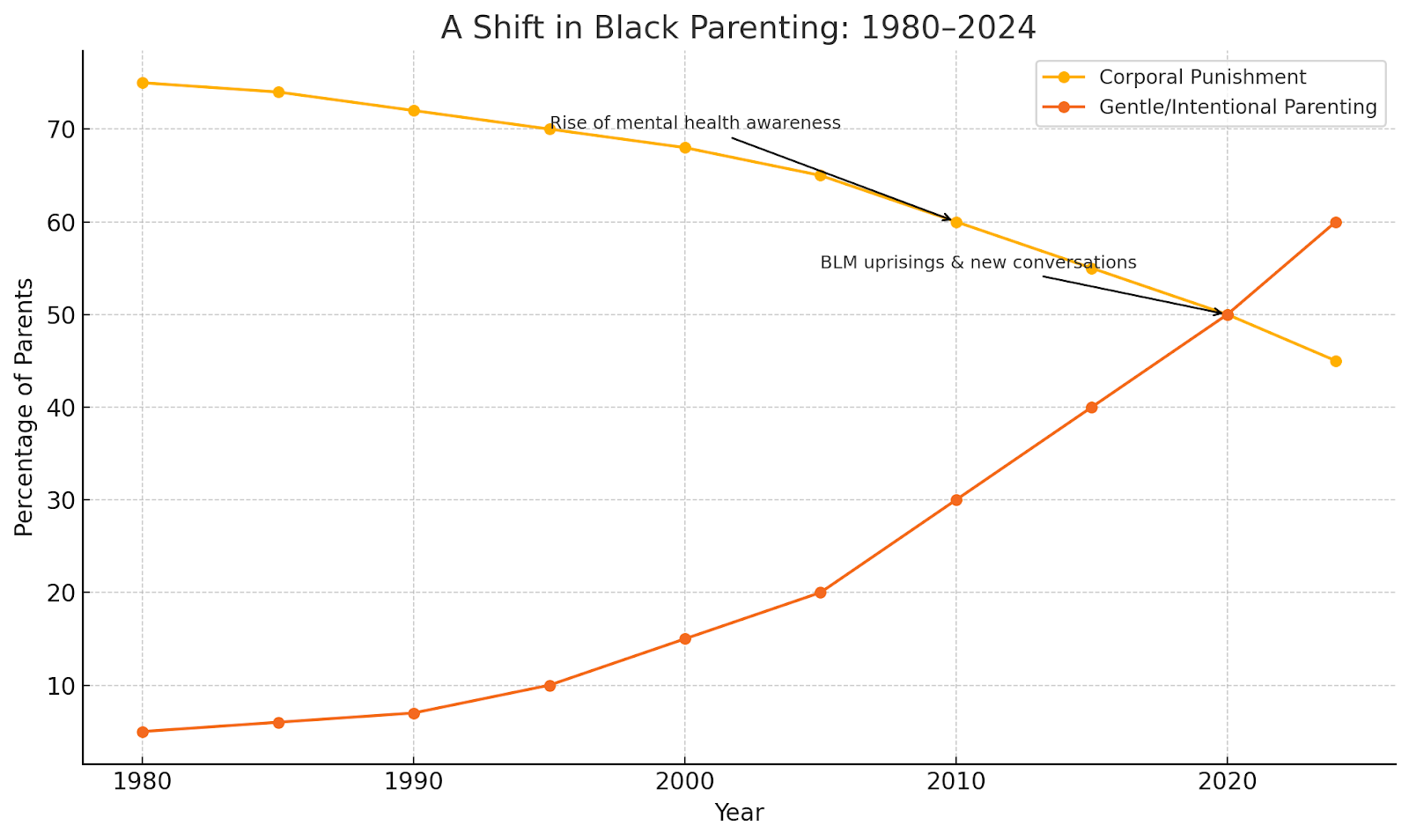
Yet today, as conversations around mental health, trauma and emotional intelligence expand, many Black mothers are rethinking these inherited practices. A growing number are embracing gentler, more intentional parenting styles—shifting away from the automatic use of spanking or harsh discipline and toward nurturing emotional safety, self-expression and psychological resilience.
This shift is not just a passing trend; it’s a radical response to centuries of emotional suppression and systemic oppression. At its heart is a powerful recognition: that raising successful, thriving Black children means prioritizing responsibility and accountability, self-worth, vulnerability and emotional well-being.
A History Rooted in Survival
The origins of strict discipline in Black households are deeply intertwined with America’s racial history. From slavery through Jim Crow and beyond, Black parents often adopted a “no-nonsense” approach to parenting, not out of cruelty, but from a fierce love and a desire to shield their children from the world’s brutalities.
“The tough love approach functioned as a survival mechanism. If you got spanked, it was because your parents wanted to protect you from something worse out there,” said Dr. Stacey Patton, author of Spare the Kids: Why Whupping Children Won’t Save Black America. “But survival-based parenting doesn’t serve us anymore. It’s time to evolve.”
A Pew Research study found that Black parents are about twice as likely as white parents to use physical discipline. For many, it’s what they knew—and what they thought worked. But Patton argues that it’s not about what “worked.” It’s about what was normalized.
“People say, ‘I got spanked and I turned out fine,’” she said. “But if you really turned out fine, you’d be able to say, ‘That didn’t feel like love. That felt like fear.’”
The Science Hehind the Shift
UTMB Director of Behavioral Health Dr. Jeremy Temple said the research is clear: corporal punishment has lasting negative effects.
“We know that both in the short term and long term, experiencing corporal punishment is linked to detrimental mental health outcomes—depression, anxiety, PTSD and a host of other problems. We’ve found that corporal punishment not only harms a child’s mental health but can damage their relationship with the person delivering it, especially if it’s someone they admire, like a parent. In those cases, children are also more likely to emulate the behavior. What’s happening is that kids are learning to solve problems through aggression. I don’t blame parents—this is what they’ve been told, generation after generation. They may have experienced corporal punishment themselves and remember it as something that corrected their behavior. But we have overwhelming evidence that it’s harmful and ineffective. There are much more effective ways to change behavior.”
Patton also points to overwhelming scientific evidence that shows physical punishment, no matter how mild, causes toxic stress in children.
“When a child is hit, the brain enters survival mode. Cortisol floods the body, the fight-or-flight response kicks in and the brain literally can’t learn in that moment,” she explained. “It rewires how a child processes emotion, regulates behavior and even how their immune system functions.”
She emphasizes that spanking, verbal degradation and other harsh tactics aren’t teaching tools—they are trauma responses.
“You’re not disciplining. You’re dysregulated. And your child learns that love is fear, that power is pain.”
“People parent the way they were parented,” Patton adds. “There’s a belief that hitting children teaches them lessons—but that’s not how the brain works.”
Patton is clear: spanking isn’t just ineffective, it’s harmful.
“People think, ‘If I don’t leave a mark, there’s no damage.’ But there are things happening under the skin you can’t see. The body is wired to go into fight-or-flight mode during a threat to survival,” Patton said. “That cortisol surge, that stress—it rewires the brain over time. It alters how children learn, process emotions, and even how their immune systems develop.”
Patton warns that while physical punishment may not leave visible scars, it can leave deep neurological wounds.
“The brain doesn’t differentiate between types of violence. Whether it’s spanking, abuse that leaves marks or even sexual abuse, they all trigger the same neurochemical response. All are toxic stress events.”
Letting Go of Parenting Through Fear
This awakening has inspired a growing number of Black mothers to parent with greater intention, embracing gentler approaches that prioritize emotional intelligence, open communication and accountability without violence.
Trina Greene, the founder of the Black parenting website Parenting for Liberation, reflects on her internal struggle. Before having her son, Trina worked in anti-incarceration advocacy, championing the idea that Black youth deserve to be heard. But once she became a mother, she admits, “those values went out the window.” She found herself defaulting to authoritarian methods, barking orders and issuing ultimatums.
“I had to ask myself: Why am I doing this? Why am I trying to control every little thing my son does?”
Trina realized that fear—fear of racism, fear of judgment, fear of failure—was driving her parenting choices.
“I was trying to shape my son in ways that would protect him from racism, but in doing so, I was crushing his spirit,” she says.
The emotional toll became apparent.
“When I parented from a place of fear, my son mirrored that fear,” she said. “He became more timid, more anxious.”
Over time, Trina consciously tried to parent with curiosity rather than control, asking herself: Is my child thriving? Is he mentally and emotionally well?
She began allowing her son to speak up when he felt she was being too harsh or reactive—a simple yet revolutionary shift that transformed his confidence and sense of self-worth.
“It was a small revolution in our home,” Trina says. “We don’t have to stay in survival mode. We can unlearn old habits and create new ways of raising our children.”
A Cultural Turning Point
Research supports what Trina and other parents are discovering: corporal punishment is linked to long-term negative outcomes, including increased aggression, anxiety and strained parent-child relationships. The American Academy of Pediatrics, for example, now strongly advises against spanking altogether, citing its harmful psychological effects.
For Black parents—especially Black mothers—this cultural shift represents a personal evolution and a broader reimagining of what liberation looks like within the home. It’s a quiet revolution rooted in love, healing and the belief that Black children deserve protection from harm and the complete freedom to grow into their most authentic selves.
As the discussion on mental health grows, more Black mothers are turning to gentle parenting—a style that focuses on patience, emotional validation and open communication rather than corporal punishment or harsh discipline. This approach encourages Black children to express their emotions, develop emotional intelligence, and learn through positive reinforcement rather than fear.
Dr. Deidre Lodrig, a Black mother and Houston child educator who practices gentle parenting, shares, “I embraced gentle parenting because I realized that I wanted my children to feel safe expressing their feelings. Growing up, I was told to ‘toughen up’ and keep my emotions in check. But I saw how those feelings were suppressed and how I struggled as an adult. I didn’t want that for my children.”
While the shift to gentler methods empowers many families, it does not come without its challenges. Lodrig explains, “At first, it was difficult because I was raised with strict discipline. I had to unlearn a lot of things I thought were necessary to raise good children. Now, I focus on listening to my kids, helping them understand their emotions and offering guidance rather than punishment.”
Breaking Generational Cycles
For many Black mothers, embracing a gentler approach to parenting, therapy and self-awareness plays a crucial role in breaking generational cycles. Recognizing that the “tough love” methods they were raised with may have been beneficial in one context but harmful in another, these mothers seek professional help to reshape their parenting styles.
Family therapist Alva Baldwin notes, “Therapy can be an important tool for parents to reflect on how their upbringing may be influencing how they raise their own children. A lot of Black parents, especially mothers, are having open conversations about the generational trauma they inherited and how it’s affected their own emotional health and relationships with their children.”
This shift is a form of healing, acknowledging the emotional scars of the past and choosing to break the cycle for the sake of future generations.
Concerns About Leniency
While many Black mothers are embracing the benefits of gentle parenting, there is significant pushback within some parts of the community. Critics argue that abandoning corporal punishment and the “tough love” approach may make Black children less prepared for the challenges they will face in a still-racially charged world.
One mother who still believes in the value of tough love shares, “I think gentle parenting is nice in theory, but when the world is already tough on our kids, they need to know how to handle discipline and authority. I don’t want them to grow up thinking the world owes them something.”
These concerns are valid, says Patton, but they miss the point that gentle parenting is not about eliminating discipline—it’s about balancing accountability with emotional support. It’s about teaching children how to navigate the world with emotional intelligence rather than fear of punishment.
“If hitting kids kept them out of prison, we wouldn’t be having conversations about mass incarceration or police brutality,” Patton said. “Preparing our children for a tough world by toughening them up just recreates the same cycle of harm.”
She argues that true protection lies in equipping children with tools to regulate their emotions, set boundaries, and assert their power.
“Beating children is the whitest thing you can do. We owe our kids more than survival,” she said. “We owe them joy. We owe them wholeness.”
By the Numbers: Discipline in Black Households
Spanked their child at least once
66% Black
51% White
Believe physical punishment is necessary
74% Black
2X as likely: Black parents are about twice as likely as white parents to use corporal punishment on children ages 3–5
80% of Black parents say their discipline is rooted in preparing children for racial bias and unfair treatment by society.
(Pew Research Center)