


By Aswad Walker
Is the Black Church focused on a spiritual mission or securing more money?
Many Black people asked that question after Pastor Marvin Sapp of The Chosen Vessel Church (Fort Worth) demanded that ushers lock the doors until attendees voluntarily made a collective offering of $40,000.
The Sapp incident raises questions about just how clear the general public is on Black Church finances.
For centuries, Black churches have played a central role in the social, political and economic lives of their congregants and communities. They have been able to do this largely because of the funding given by members.
But with Black Church membership or involvement (desirability) declining from 90% in 1996 to 74% today, according to Barna, a national database of spiritual indicators, where will the funds come from for the Black Church to honor its historic spiritual mission?
One reason Black people have left the church is their perceived hypocrisy or disillusionment with church leaders’ teachings and actions. Some contend church funds are being used less for ministry and more for building bigger sanctuaries and/or pastor salaries.
But is that assertion fair?
There is no one definitive number about the collective income Black churches take in from tithes and offerings. Various articles report that the amount ranges from $2 billion to $19 billion.
In 2016, Guardian religion correspondent Harriet Sherwood reported that U.S. religious institutions had a net worth of $1.2 trillion, which did not include a Black Church breakdown of revenue.
Whatever that amount is, like all institutions and households, Black churches have bills to pay and operating expenses to cover.
The Defender spoke with some local Black pastors to answer questions and demystify Black church finances.
What Most Don’t Know
When asked what it is about church finances that most people don’t know or understand, Dr. Rudy Rasmus, didn’t mince words.

“Many people wrestle with the fact that the inner workings of a church is actually a business. In other words, revenue is generated from the generosity of the constituents and operating expenses are the same as any other business.”
– Dr. Rudy Rasmus.
“The debate usually surrounds pastoral compensation and benefits in relation to other industries.”
Johnny Ogletree, pastor of First Metropolitan Church (8870 W. Sam Houston Pkwy North, Houston, 77040), echoed Rasmus’s sentiments.
“What most people don’t understand about church finances is the business aspect of what needs to be done to run a modern ministry,” shared Ogletree. “Of course, we know that there’s a spiritual component to everything that we do. But there are business organization types of things that have to happen.
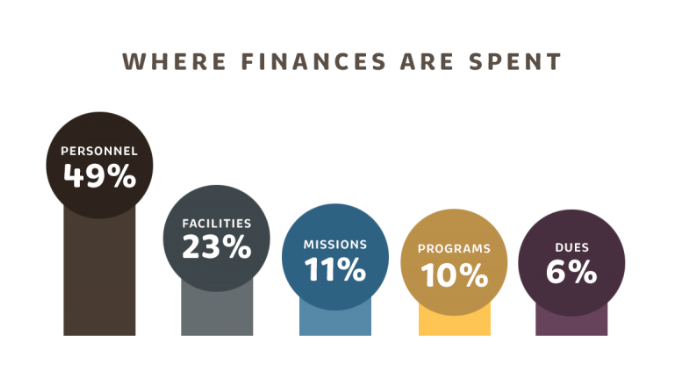
“Just like every home has income and expenses, churches have those as well. We monitor staff. We also have the responsibility, in this modern age also of property, and being responsible for managing property, and also debt that comes along sometimes with property and owning buildings, as well.”
Intersection of Faith, Finance

Central to the angst of Black people who left the church is the issue of the intersection of faith and institutional finances—in other words, the belief that church funds are used less to strengthen congregants’ faith than for other reasons.
Ogletree identified that intersection as property management.
“The same thing that the Bible teaches us about being good stewards of our money is the same thing that we have to do as a church,” said Ogletree. “We look at tithes and offerings, and based upon the tithes and offerings, we make budgets. And we do our best to manage the money properly to where we don’t go over budget.
“And we’re able to do the things that we have envisioned to do. And every home has to do that as well.”
Though that sounds like a list of numbers and bottom lines, Ogletree asserts that the presence of the Holy Spirit is also involved.
“There are some things we desire to do that are outside of the scope of what we can financially see. But our faith allows us to be able to continue pressing towards those things that don’t always make financial sense,” said Ogletree. “Understanding that we can get close enough to it from a faith standpoint, where we have expectations that God will provide what’s needed to do the thing that’s needed to touch the community in the way that the kingdom needs to advance.”
Rasmus suggested one level of misunderstanding the general public has about churches and their finances centers around how he and potentially other pastors view budgets.
“Our institutional priorities have always focused on the least empowered persons in our community as our funding priorities,” said Rasmus. “Regardless of the size of the business, government agency or church, I honestly believe budgets are moral documents that reflect the heart of the company or institution.
“Just as the Bible says, ‘For where your treasure is, there your heart will be also’ (Matt.6:21), there is an inescapable correlation between the way funds are expended and the expressed priorities of any business or church entity.”
All About the Money?
Ogletree and Rasmus took two different approaches to answering how they respond to the point made by some that all churches care about is money.
“The institutional church has been its own worst enemy over the years in the way it has poorly managed branding, and it’s not a new phenomenon,” said Rasmus. “My dad taught me as a young person to not trust preachers based on his own suspicions of questionable pastoral integrity.
“I ultimately became a pastor and spent my entire career proving to him and others that it can be done with integrity. But to answer your question, it’s true, one bad apple can spoil the bunch,” added Rasmus. “A few bad apples (or pastors) have made it harder on the public image of integral leaders in the church industry. An integral church is no more focused on money than any other business that has to pay bills.”
Ogletree said all churches must be concerned with money to the extent that money is a tool used for ministry.
“There are some things that don’t cost money, [like] the heart and those who volunteer their time to go out and do kingdom work as far as an evangelist or volunteering their time to do kind deeds,” said Ogletree. “But almost every aspect of what we do requires some type of funds. But we depend upon the Holy Spirit to be that provider to minister to people, to touch people’s hearts, to instruct them, and to give them the faith enough to desire to be generous, to do the things that are necessary to help the community.
“But every organization, every business, even in this economy that we see, has to have financial resources to do ministry.”